Gold ₹--/g Silver ₹--/g INR ₹-- Delhi --°C
Home Services Blog Tools About Contact 💬 WhatsApp

Income Tax Slabs 2026-27 — New vs Old Regime Comparison

By Parul Singh, GST Practitioner · Income Tax · Updated June 2026
Advertisement

New Tax Regime -- FY 2026-27 (AY 2027-28)

Every February, my Karol Bagh office fills with salaried employees asking which regime to choose. After analyzing 1,000+ returns, the answer depends on your deductions. The new tax regime (Section 115BAC) has been the default regime since FY 2023-24. It offers lower tax rates but fewer deductions and exemptions.
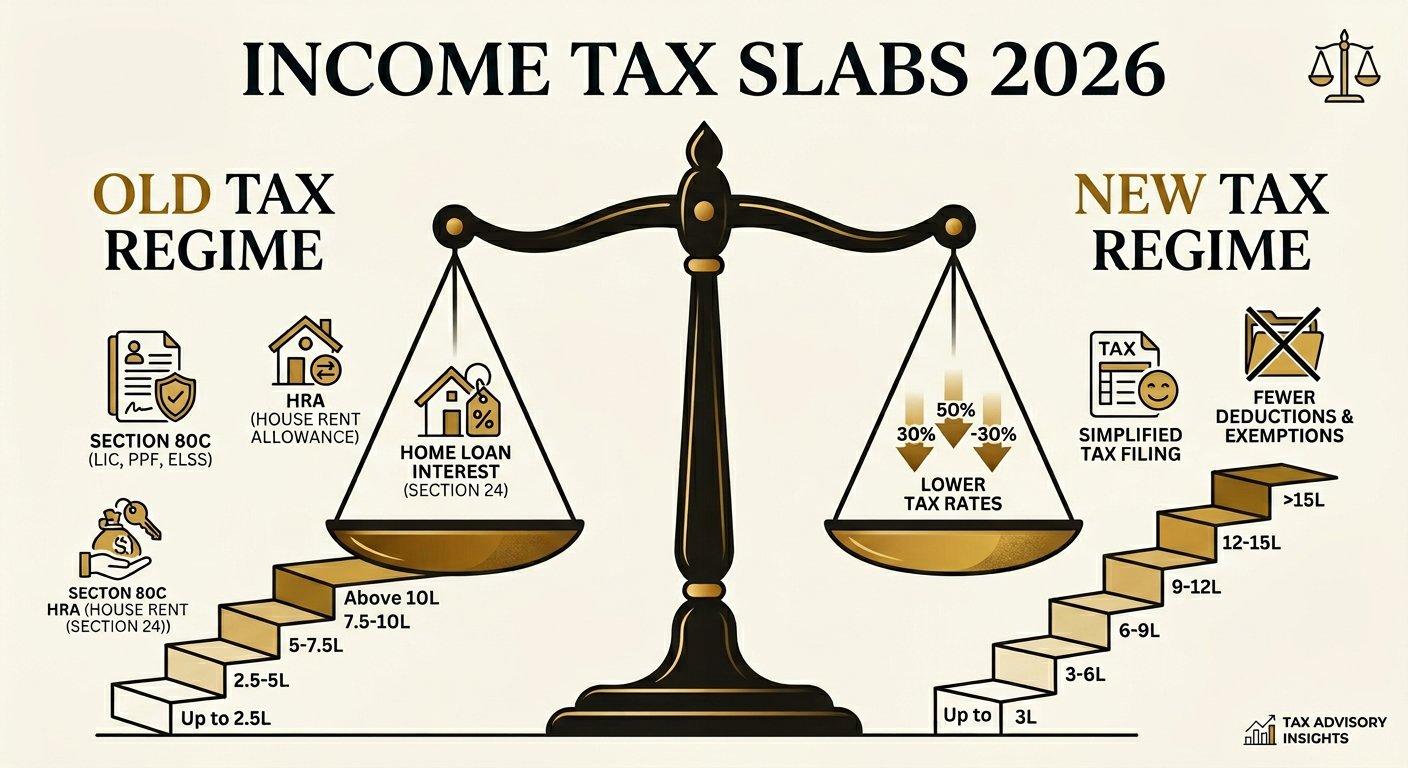
Income Tax Slabs 2026 -- New vs Old Regime Comparison
New vs Old Tax Regime -- which saves you more tax?
Official Reference: Section 115BAC of the Income Tax Act 1961, introduced by the Finance Act 2020 and modified by Finance Act 2023, provides the new tax regime with reduced rates but restricted deductions. The Budget 2024 further increased the standard deduction to ₹75,000 and adjusted slabs.
Income Slab (₹)Tax Rate
0 - 4,00,000Nil
4,00,001 - 8,00,0005%
8,00,001 - 12,00,00010%
12,00,001 - 16,00,00015%
16,00,001 - 20,00,00020%
20,00,001 - 24,00,00025%
Above 24,00,00030%
  • Standard deduction: ₹75,000 (salaried & pensioners)
  • Rebate u/s 87A: Up to ₹60,000 (effective tax-free income up to ₹12 lakh for salaried)
  • Surcharge: 10% above ₹50L, 15% above ₹1Cr, 25% above ₹2Cr
  • Cess: 4% Health & Education Cess on tax + surcharge
📍 Real Example -- Salaried Employee, ₹12 Lakh CTC
Ravi, working at a bank in Connaught Place, earns ₹12,00,000 CTC.
• Gross income: ₹12,00,000
• Standard deduction: ₹75,000
• Taxable income: ₹11,25,000
• Tax: ₹4,00,001-8,00,000 @5% = ₹20,000 + ₹8,00,001-11,25,000 @10% = ₹32,500
• Total tax: ₹52,500
• After 87A rebate (₹52,500): ₹0
Net tax = ZERO

Old Tax Regime -- FY 2026-27

The old regime allows all traditional deductions and exemptions. It benefits taxpayers who have significant investments under Section 80C, home loan interest, HRA, and other deductions. In my experience, if your total deductions exceed ₹3.75 lakh, the old regime saves you money.

Income Slab (₹)Tax Rate
0 - 2,50,000Nil
2,50,001 - 5,00,0005%
5,00,001 - 10,00,00020%
Above 10,00,00030%
  • Section 80C: Up to ₹1.5 lakh (PPF, ELSS, LIC, NPS, home loan principal)
  • Section 80D: Up to ₹25,000 (₹50,000 for senior citizens) medical insurance
  • HRA exemption: For salaried staying in rented accommodation
  • Section 24(b): Up to ₹2 lakh home loan interest
  • Standard deduction: ₹50,000
Official Reference: Section 80C of the Income Tax Act allows deduction up to ₹1.5 lakh for specified investments. Section 80D allows up to ₹25,000/₹50,000 for medical insurance premium. Section 24(b) allows up to ₹2 lakh deduction for home loan interest on self-occupied property.

Side-by-Side Comparison

FeatureNew RegimeOld Regime
Basic exemption₹4,00,000₹2,50,000
Standard deduction₹75,000₹50,000
Section 80CNot availableUp to ₹1.5L
HRA exemptionNot availableAvailable
Home loan interestNot availableUp to ₹2L u/s 24(b)
Rebate 87AUp to ₹60,000Up to ₹12,500
Default regimeYesMust opt-in

Tax Calculation Examples

Let me show you with real numbers -- these are the kinds of calculations I do every day for clients in my Delhi office:

Example 1: Salaried, ₹10 lakh income, minimal deductions

New RegimeOld Regime
Gross income₹10,00,000₹10,00,000
Standard deduction₹75,000₹50,000
Sec 80C--₹1,00,000
Taxable income₹9,25,000₹8,50,000
Tax₹40,000₹72,500
After rebate₹0₹60,000

Winner: New Regime -- saves ₹60,000 thanks to the 87A rebate.

📍 Real Example -- Dwarka Homeowner, ₹18 Lakh Salary
Sunita, a manager in Dwarka, earns ₹18 lakh. She has: PPF ₹1.5L (80C), home loan interest ₹2L (24b), medical insurance ₹35K (80D), HRA exemption ₹1.2L. Total deductions: ₹5,55,000.

Old Regime: Taxable = ₹18L - ₹50K - ₹5.55L = ₹11.95L → Tax = ₹1,73,500 + 4% cess = ₹1,80,440
New Regime: Taxable = ₹18L - ₹75K = ₹17.25L → Tax = ₹2,13,750 + 4% cess = ₹2,22,300

Old Regime saves ₹41,860!

How to Choose the Right Regime

  • Choose New Regime if: Income below ₹12L (salaried), minimal investments, want simplicity
  • Choose Old Regime if: You claim ₹3.75L+ in deductions, have home loan, significant 80C investments
  • Use our Income Tax Calculator to compare both regimes with your actual income and deductions
💡 Pro Tip from Parul: Salaried employees can switch regimes every year. So try both and pick the one that saves more. Business owners and professionals: once you opt out of the new regime, you can opt back in only once. Choose carefully the first time.

Common Mistakes in Choosing Tax Regime

⚠️ Common Mistake: The biggest mistake I see: people choose the old regime because their parents or friends did, without actually calculating. At ₹10 lakh income with less than ₹2.5L deductions, the new regime saves ₹30,000-60,000. Always calculate BOTH before choosing.
💡 Pro Tip from Parul: Need help choosing the right regime and filing your ITR? I offer professional ITR filing starting at ₹999 -- including regime comparison, deduction optimization, and e-verification. Call/WhatsApp: +91 95401 04776
Advertisement

Frequently Asked Questions

What is the tax-free income limit under the new regime?
Under the new tax regime for FY 2026-27, salaried individuals can earn up to ₹12 lakh tax-free (after standard deduction of ₹75,000 and section 87A rebate). For non-salaried, the limit is ₹4 lakh before tax kicks in.
Can I switch between tax regimes every year?
Salaried individuals can switch between regimes every year when filing ITR. However, business owners and professionals who opt for the old regime can switch to new only once, and must continue with new unless they opt out again.
Is NPS deduction available under new regime?
Under the new regime, only the employer's NPS contribution under Section 80CCD(2) is allowed (up to 14% of basic salary). The employee's own NPS deduction under Section 80CCD(1) is NOT available in the new regime.
Advertisement

Need Help with This?

Get expert assistance from a GST Practitioner with 15+ years experience. Fast, affordable, and reliable.

💬 WhatsApp: +91 95401 04776 Contact Us

Need Expert Help?

WhatsApp us for instant consultation

💬 WhatsApp Now
Advertisement

Related Articles

Income Tax

Income from House Property — Tax Guide with Examples

How to calculate income from house property for ITR filing — self-occupied, let-…

Income Tax

NRI Taxation in India — Complete Guide to Income Tax for Non-Resident Indians

Understand NRI taxation — residential status, taxable income in India, DTAA bene…

Income Tax

Old vs New Tax Regime 2026-27 — Which One Should You Choose? Complete Comparison

Detailed comparison of old and new tax regimes for FY 2026-27. Use our examples …

View All Articles →