Gold ₹--/g Silver ₹--/g INR ₹-- Delhi --°C
Home Services Blog Tools About Contact 💬 WhatsApp

What is GST? A Complete Guide for Indian Businesses in 2026

By Parul Singh, GST Practitioner · GST Basics · Updated June 2026
Advertisement

What is GST?

In my 15+ years as a GST Practitioner in Karol Bagh, New Delhi, I have helped over 1,500 businesses understand and comply with GST. Before 1st July 2017, India had a chaotic indirect tax system — VAT, service tax, central excise, octroi, entry tax, and luxury tax were all levied at different stages by different authorities. A single product could be taxed 5+ times before reaching the consumer, creating what we call the cascading effect or "tax on tax."
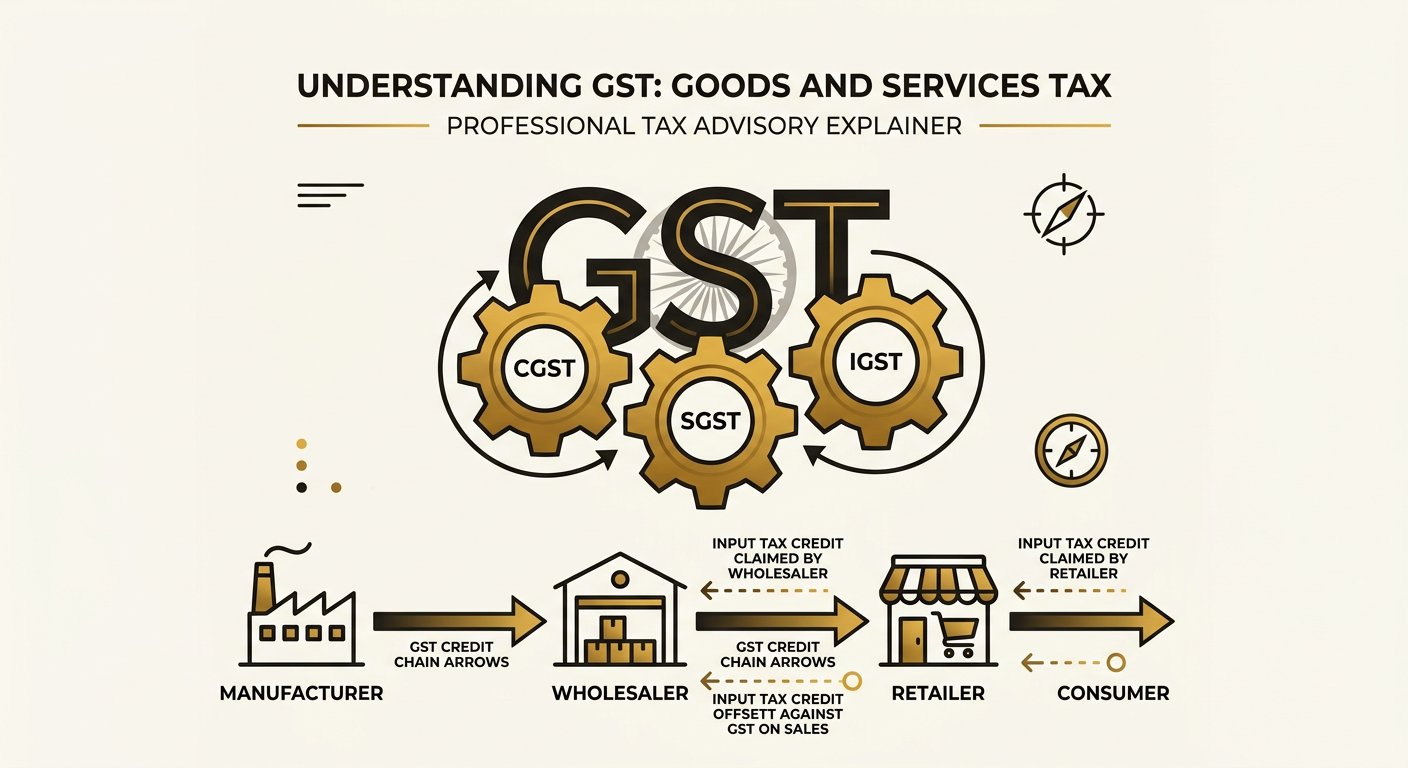
What is GST — Types, Thresholds and Credit Chain Explained
GST in India — CGST, SGST, IGST and the seamless credit chain

Goods and Services Tax (GST) changed all of that. Launched on 1 July 2017 under the Constitution (101st Amendment) Act, 2016, GST is a destination-based, multi-stage tax levied on every value addition. It replaced 17 central and state taxes and 23 cesses with a single, unified tax structure.

Official Reference: Article 246A of the Indian Constitution gives concurrent power to both Parliament and State Legislatures to make laws on GST. The CGST Act 2017 and SGST Acts of each state were enacted under this constitutional provision.
📍 Real Example — Karol Bagh Trader
Before GST, a textile trader in Karol Bagh selling to a buyer in Maharashtra paid: Central Excise (12.5%), VAT (5% on excise-included price), and Entry Tax in Maharashtra (1-2%). Effective tax: 18-20% with cascading. Under GST, the same sale attracts 5% IGST — one tax, full credit chain.

As of 2026, India's GST system has matured significantly with monthly collections consistently exceeding ₹1.94 lakh crore. The GST Council, chaired by the Union Finance Minister, has made over 50 rate changes since inception, continually refining the system.

Types of GST in India

GST in India follows a dual model — both the Centre and States levy it simultaneously on the same transaction. Understanding the types is critical for any business, whether you are a small trader in Chandni Chowk or a large manufacturer in Okhla.

Official Reference: Section 9 of the CGST Act 2017 levies CGST on intra-state supplies. Section 5 of the IGST Act 2017 levies IGST on inter-state supplies. Each state has its own SGST Act mirroring CGST provisions.
TypeFull FormLevied ByWhen Applicable
CGSTCentral GSTCentral GovernmentIntra-state supply
SGSTState GSTState GovernmentIntra-state supply
IGSTIntegrated GSTCentral GovernmentInter-state supply & imports
UTGSTUnion Territory GSTUnion TerritoryIntra-UT supply
📍 Real Example — Delhi to Delhi vs Delhi to Mumbai
Intra-state: A dealer in Connaught Place sells goods worth ₹10,000 to a buyer in Dwarka (both Delhi) at 18% GST:
• CGST @ 9% = ₹900
• SGST @ 9% = ₹900
• Total GST = ₹1,800

Inter-state: Same dealer sells to Mumbai buyer:
• IGST @ 18% = ₹1,800 (single component)
💡 Pro Tip from Parul: If you supply goods to buyers in other states, you always charge IGST — even if the value is ₹1. I see many Delhi businesses incorrectly splitting CGST+SGST on inter-state invoices. This is wrong and will cause ITC matching failures for your buyers.

GST Registration Thresholds

Not every business needs to register for GST. The thresholds vary by state category, type of supply, and business type. As a GST consultant in Delhi, I get 20+ calls every week asking Do I need GST registration? — here is the definitive answer.

Official Reference: Section 22 of the CGST Act 2017 mandates registration for suppliers exceeding the aggregate turnover threshold. Section 24 lists categories where registration is mandatory regardless of turnover.
CategoryThreshold (Annual Turnover)
Normal category states (goods)₹40 lakh
Special category states (goods)₹20 lakh
Service providers₹20 lakh (₹10 lakh for special states)
E-commerce operatorsNo threshold — must register
Inter-state suppliers₹20 lakh
Input Service DistributorsMandatory regardless of turnover
📍 Real Example — Nehru Place IT Services
Rahul, a freelance IT consultant in Nehru Place, earns ₹18 lakh/year from local Delhi clients. Since his turnover is below ₹20 lakh and all supplies are intra-state, registration is optional. But when he got a ₹2 lakh project from a client in Bangalore, his aggregate turnover crossed ₹20 lakh and he was supplying inter-state — both conditions made registration mandatory. He registered within 30 days to avoid penalty.
⚠️ Common Mistake: Many Delhi businesses think the ₹40 lakh threshold applies to services. It does not. For service providers, the threshold is only ₹20 lakh. And if you make even one inter-state sale, you must register regardless of turnover (though this ₹20 lakh exemption for inter-state suppliers was introduced — check current status).

How GST Works — The Credit Chain

The real power of GST lies in the Input Tax Credit (ITC) mechanism. Under the old regime, you paid tax on your purchases but could not claim credit across different tax types. Under GST, every person in the supply chain can claim credit for the GST paid on their purchases — creating a seamless credit chain.

Official Reference: Section 16 of the CGST Act 2017 lays down the conditions for claiming ITC: (1) possession of tax invoice, (2) receipt of goods/services, (3) furnishing of return under Section 39, and (4) payment to supplier within 180 days.

Here is how the credit chain works at each stage:

  1. Manufacturer buys raw materials for ₹100 + ₹18 GST. Sells finished goods for ₹200 + ₹36 GST. Pays ₹36 - ₹18 = ₹18 net GST.
  2. Wholesaler buys for ₹200 + ₹36 GST. Sells for ₹300 + ₹54 GST. Pays ₹54 - ₹36 = ₹18 net GST.
  3. Retailer buys for ₹300 + ₹54 GST. Sells for ₹400 + ₹72 GST. Pays ₹72 - ₹54 = ₹18 net GST.

Total tax collected: ₹72 on a value addition of ₹400 — exactly 18% of the final price, with no cascading. Each person pays only the tax on their value addition.

📍 Real Example — Okhla Manufacturer
A steel furniture manufacturer in Okhla Industrial Area buys raw steel for ₹5,00,000 + ₹90,000 GST (18%). After processing, he sells furniture for ₹8,00,000 + ₹1,44,000 GST. His net GST payable = ₹1,44,000 - ₹90,000 = ₹54,000. He pays only the tax on his ₹3,00,000 value addition. Before GST, he would have paid excise + VAT with no cross-credit, effectively paying tax on tax.
💡 Pro Tip from Parul: Always match your GSTR-2A with your purchase register before filing GSTR-3B. If a supplier has not filed their GSTR-1, you cannot claim ITC on those purchases. I recommend following up with top 10 suppliers every month to ensure they file on time.

Benefits of GST

Despite initial implementation challenges, GST has delivered significant benefits to the Indian economy and businesses:

  • One Nation, One Tax: Unified tax structure across India — no more navigating different state VAT laws
  • Elimination of cascading: ITC ensures tax is only on value addition, reducing effective tax burden by 25-30% on most goods
  • Simplified compliance: Single online portal (gst.gov.in) for everything — registration, returns, refunds
  • Lower overall tax burden: Most essential goods are cheaper than pre-GST due to lower rates and credit mechanism
  • Logistics efficiency: No border check-posts, faster movement of goods — a truck from Delhi to Mumbai now takes 30% less time
  • Formal economy growth: GST registration has brought 1.4+ crore businesses into the formal economy

Basic GST Compliance Requirements

Running a business in Delhi without GST compliance is like driving without a license — you will get caught eventually. Here are the basics every registered taxpayer must follow:

  • GST Registration: Within 30 days of crossing threshold (Section 22)
  • GSTR-1: Monthly/quarterly filing of outward supplies by 11th of next month
  • GSTR-3B: Monthly summary return with tax payment by 20th
  • E-way Bill: For movement of goods above ₹50,000 (Rule 138)
  • E-invoice: Mandatory for businesses above ₹5 crore turnover
  • Annual Return (GSTR-9): Yearly reconciliation by 31st December

Common GST Mistakes I See in Delhi

In my practice, I see the same mistakes repeated across businesses — from traders in Gandhi Nagar to startups in Nehru Place:

  • Not registering when required — especially freelancers doing inter-state work
  • Wrong type of GST charged — CGST+SGST on inter-state sales instead of IGST
  • Not claiming ITC — many small businesses do not even know they can claim credit
  • Late filing — ₹50/day late fee adds up quickly; I have seen businesses owe ₹25,000+ in just late fees
  • Incorrect HSN codes — wrong classification means wrong rate and potential demand notice
💡 Pro Tip from Parul: If you are a small business owner in Delhi looking for a reliable GST advisor near you, feel free to reach out. I handle everything from registration to monthly returns to annual audits — so you can focus on growing your business. Call/WhatsApp: +91 95401 04776
Advertisement

Frequently Asked Questions

When was GST implemented in India?
GST was implemented on 1 July 2017 through the Constitution (101st Amendment) Act, 2016. It replaced multiple central and state indirect taxes with a unified tax structure.
What is the current GST registration threshold?
For goods suppliers in normal category states like Delhi, the threshold is ₹40 lakh. For service providers, it is ₹20 lakh. E-commerce operators must register regardless of turnover. Inter-state suppliers must register if turnover exceeds ₹20 lakh.
Can I register for GST voluntarily?
Yes, any person can voluntarily register for GST even if their turnover is below the threshold. This is beneficial for claiming ITC and establishing credibility with large businesses. Many B2B suppliers in Connaught Place and Nehru Place register voluntarily to appear more professional.
What are the GST rates in India?
GST has five rate slabs: 0%, 5%, 12%, 18%, and 28%. Essential items like food grains are at 0%, while luxury and sin goods attract 28% plus cess. Most goods and services fall in the 18% slab.
Advertisement

Need Help with This?

Get expert assistance from a GST Practitioner with 15+ years experience. Fast, affordable, and reliable.

💬 WhatsApp: +91 95401 04776 Contact Us

Need Expert Help?

WhatsApp us for instant consultation

💬 WhatsApp Now
Advertisement

Related Articles

GST Registration

GST Registration Process 2026 — Step-by-Step Guide with Documents Required

Complete guide to GST registration in India. Learn who needs to register, docume…

GST Returns

How to File GSTR-1 in 2026 — Complete Guide with Examples

Step-by-step guide to filing GSTR-1 (outward supplies return). Learn about diffe…

GST Returns

GSTR-3B Filing Guide 2026 — Summary Return Made Simple

Master GSTR-3B filing — understand each table, how to claim ITC, due dates, late…

View All Articles →